John Shiwak: A Hero’s Journey from Labrador to the Battlefields of World War I

Image:
Lance Corporal John Shiwak during the First World War.
John Shiwak was born in 1889 in Cul-de-Sac, a small settlement near
Rigolet, Labrador. Growing up in the harsh northern wilderness, Shiwak learned
to hunt, fish, and trap from a young age. His skills as a hunter and trapper
would later serve him well on the battlefields of Europe. Shiwak's life took a
dramatic turn when he joined the Royal Newfoundland Regiment on July 24, 1915,
driven to see the world and serve his country. At the time, he stood only five
feet, five inches tall and weighed 132 pounds.
William Lacey Amy, a writer and journalist, played a significant part in
documenting and shaping the public's understanding of John Shiwak's life. Amy
first met Shiwak in 1911 during a trip from St. John's to Rigolet, Labrador.
The two became fast friends, and Shiwak's subsequent letters to Amy provide
insight into the Inuit warrior's early life and aspirations.
Amy saw Shiwak as a "natural poet, a natural artist, a natural
narrator," highlighting his innate storytelling abilities and artistic
talents. The correspondence between the two men would continue until Shiwak
enlisted in the Royal Newfoundland Regiment in 1915. Amy recounts the events of
Shiwak's life, along with his journey from Labrador to the battlefields of
Europe, and these have become essential writings which ensure that Shiwak's
legacy continues.
Shiwak became interested in the military. His eventual enlistment was
most certainly influenced by his interactions with Amy and his exposure to the
League of Frontiersmen, a paramilitary organization established in Newfoundland
and Labrador. Amy's portrayal of Shiwak as a capable and ambitious individual
likely contributed to Shiwak's decision to join the war effort.
William Lacey Amy's effect on Shiwak's life was profound. He provided a
platform for Shiwak's story to be told to a broader audience, thus ensuring
that his contributions and sacrifices would always be remembered.
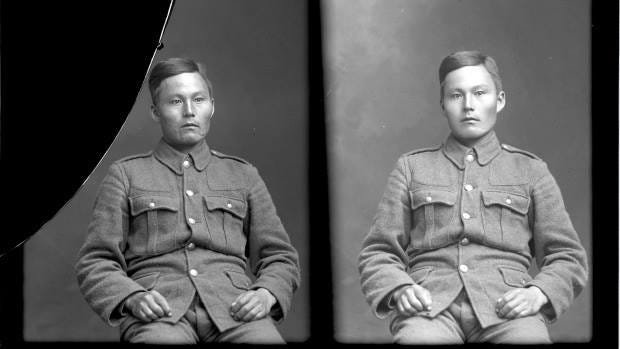
Image: John Shiwak, Royal Newfoundland Regiment. Regimental # 1735.
Shiwak quickly distinguished himself as an exceptional sniper, which
earned him the lasting respect of his fellow soldiers in the Royal Newfoundland
Regiment. His patience was endless, and his eyesight was second to none. His
skills as a sniper had been honed through years and years of hunting seals and
other wildlife in Labrador, which made him one of the preeminent snipers in the
British Empire. In April 1917, Shiwak was promoted to Lance Corporal, a feat
that took him only nine months of duty at the front to achieve, a true
testament to his bravery and skill.
While overseas, Shiwak formed a close friendship with Howard Lorry, a
fellow Newfoundlander and member of the Royal Newfoundland Regiment. Lorry
often visited Shiwak at his sniping outpost, and the two would spend hours
talking about their shared experiences hunting seals and ducks back home in
Labrador. Lorry noted that Shiwak's eyes would light up when they discussed
hunting, and he admired Shiwak's patience and accuracy as a sniper. "He
was shy and lonely, but I got to be quite friendly with him by talking of seal
and duck hunting... His eyes would light up," wrote Lorry. He noted the
many notches on Shiwak's rifle stock— "He must have killed a lot of
Germans." Lorry wrote that the two men would talk for hours, with Shiwak
constantly on watch. "He often sighed and said, 'Will it ever be
over?'" noted Lorry.
Lorry described Shiwak as shy and lonely, but their conversations helped
to alleviate some of the isolation and stress of war. Shiwak confided in Lorry
about his longing to go home to see his family and be out hunting on the ice
again.
He also spoke and wrote often about his great desire to be with his
fiancee Louisa—who was most likely Louisa Flowers of Valley Bight on Lake
Melville. One letter was sent from France to "My Dear Louisa," who
Shiwak thought of "every Day even when I am in the line." The
letters, along with the friendships he fostered amongst other men in his
Regiment, gave him a profound sense of comfort and connection amidst the utter
chaos of the battlefield, despite his fiance's family's opposition to the
proposed union.

Image: John Shiwak during World War I.
Their friendship was a great source of support for Shiwak, especially
after two of his friends died in April 1917, one of whom was his close friend
and former trapping companion, William McKenzie of Rigolet. This left him
quieter and more sad. Despite the hardships, Shiwak's bond with Lorry and their
shared memories of hunting and home helped to sustain him during his time at
the front.
The Battle of Cambrai, which began on November 20, 1917, was a major
offensive by the Allies aimed at breaking through the German Hindenburg Line.
Shiwak and his fellow soldiers of the Newfoundland Regiment were tasked with
capturing a part of the St. Quentin Canal near the village of Masnières. The
fighting was intense, and the town changed hands multiple times.
On the morning of November 21, 1917, Shiwak and six other soldiers were
killed by an exploding shell while advancing through Masnières. The shell burst
in the middle of their column, instantly claiming their lives and wounding
several others. Shiwak was buried that afternoon in a temporary grave near
where he fell, but ongoing artillery shelling erased all traces of his grave,
leaving no permanent marker.
In the July 1918 issue of The Canadian Magazine, William Amy wrote the
article "An Eskimo Patriot," which described his and Shiwak's
friendship and some of John's feelings during the war.
Amy wrote this article in late November 1917. "The duration of the
war was wearing on him. He had no close friends, none to keep warm the link
with his distant home. In September, he lamented: "I have no letters from
home since July. There will be no more now till the ice breaks". And in
his last, he longed again for the old hunting days. Labrador, who had never
satisfied his ambitions, looked warm and friendly to him now… That was in
mid-November. A month later, an official envelope came to me. Inside was my
last letter. On its face was the soulless stamp. "Deceased"."
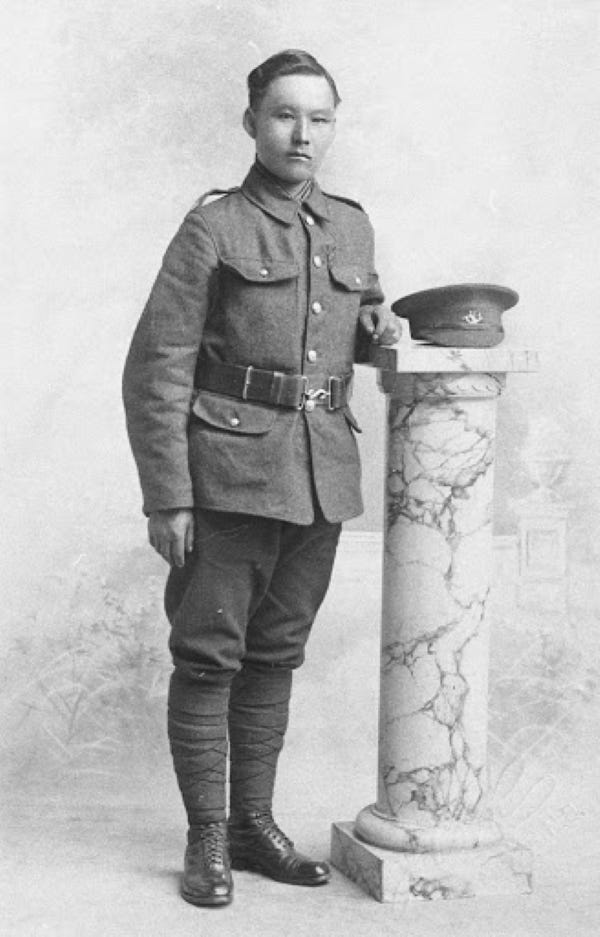
Image: John Shiwak shortly after enlisting in St. John’s in 1916.
His Regiment keenly felt Shiwak's death, as he was a skilled sniper and a reliable and well-liked comrade. His loss was a reminder of the brutal and unpredictable nature of war, where even the most experienced and courageous soldiers could fall in an instant. On February 12, 1918, R.H. Tait, Captain and Adjutant of the 1st Royal Newfoundland Regiment, wrote the following testimony about John Shiwak:
"I was present on the morning of November 21 when the above NCO was
killed. We had taken part of the village (Masnières) in the attack on the 20th,
and remained in our consolidated positions on that night. The next day we were
ordered to take up a position on the other end of the village and act as
counter attacking battalion if required."
"We assembled in the Sucrerie and, having formed up, proceded along
the canal back toward another sugar factory where Batt'n HQ was to be
located."
"The enemy at the time were shelling the bank and one shell burst
right in the middle of our column and killed seven, amongst whom was L/C
Shiwak, and wounded about ten others."
"Shiwak was buried that afternoon in the village of Masni'eres and
close to the spot where he fell. The whole Regiment keenly felt his loss as he
was a great favourite with all ranks, an excellent scout and observer, and a
thoroughly good and reliable fellow in every way."
"Shiwak will long be remembered by all who knew him."
John Shiwak was only 28 when he was killed in action. Wrote Lorry:
"I guess his spirit is back in his beloved Labrador—I would like to think
so, anyway. What a change from the stillness and quiet and whiteness of
Labrador to the mud and dirt and noise of Flanders."
Shiwak kept journals about his time at the front, including poetry,
sketches, and even watercolour paintings. Sadly, none of these journals have
been recovered.

Image: John Shiwak prior to heading off for war in 1916.
Today, John Shiwak is remembered as a hero and a symbol of the
sacrifices made by Newfoundlanders and Labradorians during World War I. In
2014, a newly constructed student residence on the Memorial University of
Newfoundland campus was named Shiwak Hall in his honour, and a commemorative
plaque was unveiled in Masnières in 2023. His legacy lives on, inspiring future
generations to honour the memory of those who gave their lives in service to
their country.
#JohnShiwak
Please consider supporting our ongoing efforts to bring you interesting and informative historical content. As our valued readers, you should know that your monthly financial support goes a long way toward helping us continue our work of bringing you Canada’s Military History regularly.
You Can Make a One-Time Donation or set up a monthly giving plan that fits your budget. You may do this at:
https://www.buymeacoffee.com/CanadasMilitaryHistory
Thank you for considering supporting us.
Michael
Canada’s Military History 2.0
Tags: #World War I; #Newfoundland and Labrador; #JohnShiwak; #Sniper; #Inuk; #The Newfoundland Regiment; #Death; #Cambrai1918
Canada's Military History 2.0 is a reader-supported publication. We truly value your support.


No comments:
Post a Comment