Friday, February 6, 2026

John Shiwak: A Hero's Journey from Labrador to the Battlefields of World War I


John Shiwak: A Hero’s Journey from Labrador to the Battlefields of World War I


Image: Lance Corporal John Shiwak during the First World War.


John Shiwak was born in 1889 in Cul-de-Sac, a small settlement near Rigolet, Labrador. Growing up in the harsh northern wilderness, Shiwak learned to hunt, fish, and trap from a young age. His skills as a hunter and trapper would later serve him well on the battlefields of Europe. Shiwak's life took a dramatic turn when he joined the Royal Newfoundland Regiment on July 24, 1915, driven to see the world and serve his country. At the time, he stood only five feet, five inches tall and weighed 132 pounds.

William Lacey Amy, a writer and journalist, played a significant part in documenting and shaping the public's understanding of John Shiwak's life. Amy first met Shiwak in 1911 during a trip from St. John's to Rigolet, Labrador. The two became fast friends, and Shiwak's subsequent letters to Amy provide insight into the Inuit warrior's early life and aspirations.

Amy saw Shiwak as a "natural poet, a natural artist, a natural narrator," highlighting his innate storytelling abilities and artistic talents. The correspondence between the two men would continue until Shiwak enlisted in the Royal Newfoundland Regiment in 1915. Amy recounts the events of Shiwak's life, along with his journey from Labrador to the battlefields of Europe, and these have become essential writings which ensure that Shiwak's legacy continues.

Shiwak became interested in the military. His eventual enlistment was most certainly influenced by his interactions with Amy and his exposure to the League of Frontiersmen, a paramilitary organization established in Newfoundland and Labrador. Amy's portrayal of Shiwak as a capable and ambitious individual likely contributed to Shiwak's decision to join the war effort.

William Lacey Amy's effect on Shiwak's life was profound. He provided a platform for Shiwak's story to be told to a broader audience, thus ensuring that his contributions and sacrifices would always be remembered.
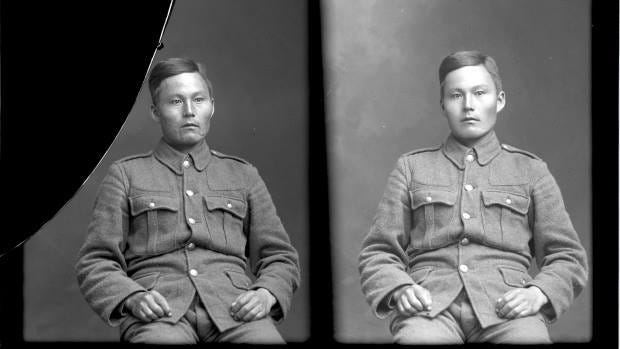
 

Image: John Shiwak, Royal Newfoundland Regiment. Regimental # 1735.

Shiwak quickly distinguished himself as an exceptional sniper, which earned him the lasting respect of his fellow soldiers in the Royal Newfoundland Regiment. His patience was endless, and his eyesight was second to none. His skills as a sniper had been honed through years and years of hunting seals and other wildlife in Labrador, which made him one of the preeminent snipers in the British Empire. In April 1917, Shiwak was promoted to Lance Corporal, a feat that took him only nine months of duty at the front to achieve, a true testament to his bravery and skill.

While overseas, Shiwak formed a close friendship with Howard Lorry, a fellow Newfoundlander and member of the Royal Newfoundland Regiment. Lorry often visited Shiwak at his sniping outpost, and the two would spend hours talking about their shared experiences hunting seals and ducks back home in Labrador. Lorry noted that Shiwak's eyes would light up when they discussed hunting, and he admired Shiwak's patience and accuracy as a sniper. "He was shy and lonely, but I got to be quite friendly with him by talking of seal and duck hunting... His eyes would light up," wrote Lorry. He noted the many notches on Shiwak's rifle stock— "He must have killed a lot of Germans." Lorry wrote that the two men would talk for hours, with Shiwak constantly on watch. "He often sighed and said, 'Will it ever be over?'" noted Lorry.

Lorry described Shiwak as shy and lonely, but their conversations helped to alleviate some of the isolation and stress of war. Shiwak confided in Lorry about his longing to go home to see his family and be out hunting on the ice again.

He also spoke and wrote often about his great desire to be with his fiancee Louisa—who was most likely Louisa Flowers of Valley Bight on Lake Melville. One letter was sent from France to "My Dear Louisa," who Shiwak thought of "every Day even when I am in the line." The letters, along with the friendships he fostered amongst other men in his Regiment, gave him a profound sense of comfort and connection amidst the utter chaos of the battlefield, despite his fiance's family's opposition to the proposed union.

Image: John Shiwak during World War I.


Their friendship was a great source of support for Shiwak, especially after two of his friends died in April 1917, one of whom was his close friend and former trapping companion, William McKenzie of Rigolet. This left him quieter and more sad. Despite the hardships, Shiwak's bond with Lorry and their shared memories of hunting and home helped to sustain him during his time at the front.

The Battle of Cambrai, which began on November 20, 1917, was a major offensive by the Allies aimed at breaking through the German Hindenburg Line. Shiwak and his fellow soldiers of the Newfoundland Regiment were tasked with capturing a part of the St. Quentin Canal near the village of Masnières. The fighting was intense, and the town changed hands multiple times.

On the morning of November 21, 1917, Shiwak and six other soldiers were killed by an exploding shell while advancing through Masnières. The shell burst in the middle of their column, instantly claiming their lives and wounding several others. Shiwak was buried that afternoon in a temporary grave near where he fell, but ongoing artillery shelling erased all traces of his grave, leaving no permanent marker.

In the July 1918 issue of The Canadian Magazine, William Amy wrote the article "An Eskimo Patriot," which described his and Shiwak's friendship and some of John's feelings during the war.

Amy wrote this article in late November 1917. "The duration of the war was wearing on him. He had no close friends, none to keep warm the link with his distant home. In September, he lamented: "I have no letters from home since July. There will be no more now till the ice breaks". And in his last, he longed again for the old hunting days. Labrador, who had never satisfied his ambitions, looked warm and friendly to him now… That was in mid-November. A month later, an official envelope came to me. Inside was my last letter. On its face was the soulless stamp. "Deceased"."
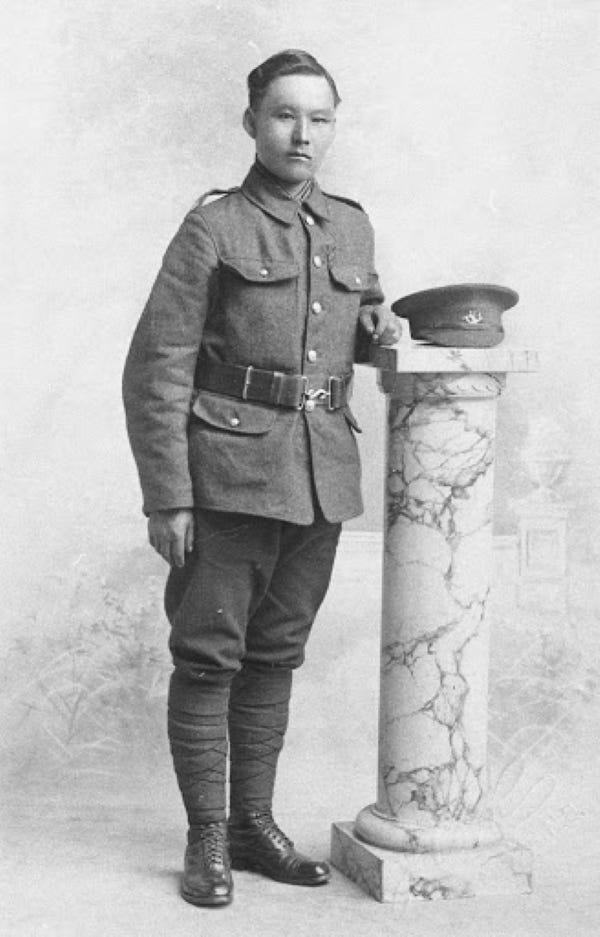
Image: John Shiwak shortly after enlisting in St. John’s in 1916.


 His Regiment keenly felt Shiwak's death, as he was a skilled sniper and a reliable and well-liked comrade. His loss was a reminder of the brutal and unpredictable nature of war, where even the most experienced and courageous soldiers could fall in an instant. On February 12, 1918, R.H. Tait, Captain and Adjutant of the 1st Royal Newfoundland Regiment, wrote the following testimony about John Shiwak:

"I was present on the morning of November 21 when the above NCO was killed. We had taken part of the village (Masnières) in the attack on the 20th, and remained in our consolidated positions on that night. The next day we were ordered to take up a position on the other end of the village and act as counter attacking battalion if required."

"We assembled in the Sucrerie and, having formed up, proceded along the canal back toward another sugar factory where Batt'n HQ was to be located."

"The enemy at the time were shelling the bank and one shell burst right in the middle of our column and killed seven, amongst whom was L/C Shiwak, and wounded about ten others."

"Shiwak was buried that afternoon in the village of Masni'eres and close to the spot where he fell. The whole Regiment keenly felt his loss as he was a great favourite with all ranks, an excellent scout and observer, and a thoroughly good and reliable fellow in every way."

"Shiwak will long be remembered by all who knew him."

John Shiwak was only 28 when he was killed in action. Wrote Lorry: "I guess his spirit is back in his beloved Labrador—I would like to think so, anyway. What a change from the stillness and quiet and whiteness of Labrador to the mud and dirt and noise of Flanders."

Shiwak kept journals about his time at the front, including poetry, sketches, and even watercolour paintings. Sadly, none of these journals have been recovered.


Image: John Shiwak prior to heading off for war in 1916.


Today, John Shiwak is remembered as a hero and a symbol of the sacrifices made by Newfoundlanders and Labradorians during World War I. In 2014, a newly constructed student residence on the Memorial University of Newfoundland campus was named Shiwak Hall in his honour, and a commemorative plaque was unveiled in Masnières in 2023. His legacy lives on, inspiring future generations to honour the memory of those who gave their lives in service to their country.


 #JohnShiwak

https://amzn.to/3Dhq6Li

Please consider supporting our ongoing efforts to bring you interesting and informative historical content. As our valued readers, you should know that your monthly financial support goes a long way toward helping us continue our work of bringing you Canada’s Military History regularly.

You Can Make a One-Time Donation or set up a monthly giving plan that fits your budget. You may do this at:

https://www.buymeacoffee.com/CanadasMilitaryHistory

Thank you for considering supporting us.

Michael

Canada’s Military History 2.0


Tags:  #World War I; #Newfoundland and Labrador; #JohnShiwak; #Sniper; #Inuk; #The Newfoundland Regiment; #Death; #Cambrai1918 


Canada's Military History 2.0 is a reader-supported publication. We truly value your support.


The Destruction of Miramichi, 1760.


A view of Miramichi, a French settlement in the Gulf of St. Laurence, which was destroyed by order of Brigadier James Murray in 1760 during the latter part of the French & Indian War. Murray, who at this time was commanding at Quebec after General Wolfe’s death, had ordered a detachment of troops to destroy French posts along the Gulf of St. Lawrence, including Miramichi.

This artwork, a line engraving and etching on laid paper, was created in 1768 by Hervey Smyth, 1734-1811, and engraved in London, England, by Paul Sandby, 1731-1809. The Image was “retouched” by P. Benazech.

#DestructionofMiramichi

https://amzn.to/3MoqtIR

Your financial support is essential to our continued ability to bring you engaging historical stories. You may support us at this address:

https://www.buymeacoffee.com/CanadasMilitaryHistory

Tuesday, January 13, 2026

"Take Up the Sword of Justice."


"Take Up the Sword of Justice."

This bold and direct British recruiting poster shows "Justice" rising from the depths of the ocean as the Lusitania, a passenger liner, sinks, drowning over 1,200 people. This event, in May 1915, triggered a massive backlash against the German nation and people.

#SwordofJustice

https://amzn.to/4jEn04X


Tags:  World War I, Propaganda, Backlash against German citizens in Canada, Internment of enemy aliens in Canada,

Friday, January 9, 2026

Steel and Sunshine: The Ontario Regiment’s Italian Interlude


Steel and Sunshine: The Ontario Regiment’s Italian Interlude  


On June 26, 1944, Number One Troop of the Ontario Regiment paused on the outskirts of Pucciarelli, Italy, for a rare moment of rest. Gathered around a makeshift outdoor table, shirtless and sun-drenched, the soldiers shared a meal in the shadow of their Sherman tank—T-147513—commanded by Battle Captain Lieutenant M.A. Maidlow. The scene, framed by a war-torn building and scattered supplies strewn about, most definitely captures the dreadful essence of war: camaraderie, exhaustion, and fleeting normalcy amid chaos¹.

This moment unfolded during the Italian Campaign, a gruelling Allied effort to push German forces north through mountainous terrain and fortified towns. The Ontario Regiment, part of the 1st Canadian Armoured Brigade, had been in the middle of the heavy fighting since the struggle in Sicily². By mid-1944, these men were battle-hardened veterans, their Shermans serving as both the spearhead and the shield in a number of tough battles which demanded coordination between infantry and armour. Pucciarelli, a small village in Tuscany, was one of many strategic waypoints in the slow, bloody march toward Rome and beyond³.

The Sherman tank in the photo—ubiquitous but far from invincible—was the backbone of Allied armoured forces. Its reliability and ease of production made it indispensable, though crews often had to compensate for its relatively thin armour and underpowered gun⁴. In Italy’s narrow roads and hilly terrain, Shermans were used creatively: for direct fire support, mobile cover, and even bulldozing through rubble. Lieutenant Maidlow’s tank, parked casually yet ready for action, symbolizes the duality of war—leisure and lethality side by side⁵.

What makes this image especially poignant is its intimacy. These men are neither in formation nor under fire; they are celebrating and eating, and talking, with the requisite amount of joking among the tired and stressed warriors. The war is still all around them—visible in the ruins, the gear, the tank—but for a moment, a brief moment, they are together. We are reminded by this scene that with every strategic advance and battlefield engagement, there are individuals living through history, one meal, one mile, one mission at a time⁶.

Today, this photograph stands as a testament to the resilience and humanity of Canadian troops in Italy. We are compelled to look beyond the machinery and the medals, to the strain on the faces of the men who fought for their country, and for their lives, and the lives of their buddies. It was these friendships among fighting men that allowed the war to continue. Pucciarelli may be a footnote in military history, but for these men, it was a chapter written in sweat, steel, and sunshine⁷.

#CanadainItaly1944

https://amzn.to/4pt4u0Z

Please consider supporting our ongoing efforts to bring you high-quality, engaging historical content. Your financial support for our website and social media presence will go a long way toward sustaining our efforts to bring you Canada’s Military History 2.0 on a regular basis. Or, if you would like, you can make a one-time donation at: https://www.buymeacoffee.com/CanadasMilitaryHistory

If you buy something through our site, we might earn a commission, but this will not affect the price you pay for the item.

Thank you for considering supporting us.

Michael

Canada’s Military History

Article Footnotes

1. Canadian Army Film and Photo Unit, “Number One Troop, Ontario Regiment, Pucciarelli, Italy,” June 26, 1944.

2 Granatstein, J.L., Canada’s Army: Waging War and Keeping the Peace, University of Toronto Press, 2002.

3 Stacey, C.P., Official History of the Canadian Army in the Second World War: Volume II – The Canadians in Italy, Queen’s Printer, 1956.

4 Zaloga, Steven J., Sherman Medium Tank 1942–45, Osprey Publishing, 1993.

5 Copp, Terry, Fields of Fire: The Canadians in Normandy, University of Toronto Press, 2003.

6 Cook, Tim, The Fight for History: 75 Years of Forgetting, Remembering, and Remaking Canada’s Second World War, Penguin Canada, 2020.

7 Dancocks, Daniel G., The D-Day Dodgers: The Canadians in Italy 1943–1945, McClelland & Stewart, 1991.

Article Bibliography

Canadian Army Film and Photo Unit. “Number One Troop, Ontario Regiment, Pucciarelli, Italy.” Photograph, June 26, 1944.

Copp, Terry. Fields of Fire: The Canadians in Normandy. Toronto: University of Toronto Press, 2003.

Cook, Tim. The Fight for History: 75 Years of Forgetting, Remembering, and Remaking Canada’s Second World War. Toronto: Penguin Canada, 2020.

Dancocks, Daniel G. The D‑Day Dodgers: The Canadians in Italy 1943–1945. Toronto: McClelland & Stewart, 1991.

Granatstein, J.L. Canada’s Army: Waging War and Keeping the Peace. Toronto: University of Toronto Press, 2002.

Stacey, C.P. Official History of the Canadian Army in the Second World War, Volume II: The Canadians in Italy, 1943–1945. Ottawa: Queen’s Printer, 1956.

Zaloga, Steven J. Sherman Medium Tank 1942–45. Oxford: Osprey Publishing, 1993.


Tags: Ontario Regiment, 1st Canadian Armoured Brigade, Lieutenant M.A. Maidlow, Sherman Tank, M4 Sherman, Canadian Armoured Corps, Canadian Army WWII, Tank Crews, Armoured Warfare, Pucciarelli Italy, Italian Campaign, Italy 1944, Tuscany WWII, Liri Valley, Gothic Line, Canadian Forces in Italy, WWII Italy, World War II History, Canadian Military History, Allied Operations, Battlefield Conditions, Soldiers at Rest, Wartime Daily Life, Combat Logistics, Armoured Operations, Military Photography, Historical Photograph, WWII Photo, Canadian War Archives, Sherman Tank Photo, Military History Visuals, Archival Imagery, War Documentation, Canada in WWII, Canadian Veterans, Canadian War Stories, Canadian Heritage, Canadian Regiments, Canadian Military Legacy, War and Memory, Military History Writing, Historical Interpretation, Human Side of War, Soldier Experience, War Narratives, Canada's Military History 2.0


Thursday, January 8, 2026

Steel Through the Hochwald: The Dragoons’ Drive in Operation Blockbuster


Steel Through the Hochwald: The Dragoons’ Drive in Operation Blockbuster


During the grim final winter of World War II, the Hochwald forest became a crucible of fire and mud. On March 2, 1945, the General Motors T17E1 Staghound armoured cars of “A” Squadron, 12th Manitoba Dragoons, rolled into this maelstrom as part of Operation Blockbuster—a Canadian-led offensive designed to shatter the German defensive line in the Rhineland’s last bastion. The goal of the Canadian/British combined force was to capture the Hochswald Gap and then advance to capture Xanten. The image captures not just machines of war, but the resolve of men who braved shellfire and sodden terrain to force a breakthrough in one of the war’s most punishing battles.

The Battle of the Hochwald Gap took place at the Hochwald Gap, a narrow corridor flanked by dense woods and fortified positions near Xanten, which was the key to unlocking Germany’s western defences. The First Canadian Army, having been reinforced by British XXX Corps, led the attack against the Germans during this critical battle. The 4th Canadian Armoured Division, along with the 10th Canadian Infantry Brigade, was chosen to lead the attack. This operation successfully melded infantry grit with armoured momentum, thus creating a truly unstoppable force. The Dragoons’ Staghounds, built primarily for reconnaissance and rapid engagement, soon became a vital part of navigating the treacherous terrain in this engagement, while maintaining pressure on retreating German units.

Conditions were hellish. Rain turned roads into quagmires, artillery churned the earth into chaos, and German resistance was unrelenting. Despite these difficulties, the Canadians continued to push forward, inch by inch, through the forested ridges and fortified lines. By March 3, they had seized the Hochwald and linked up with the American Ninth Army near Geldern—an achievement that cracked open the path to the heart of Germany. Operation Blockbuster, if it is to be remembered for anything, would be recalled for its strategic success and for the sheer tenacity of the Canadian & British troops who fought it, a tenacity which would be repeated over and over. This photograph remains to this day a testament to that resolve: steel, mud, and courage converging in the final push toward victory.


#OperationBlockbuster

https://amzn.to/3N3vB5g


Please consider supporting our ongoing efforts to bring you high-quality, engaging historical content. Your financial support for our website and social media presence will go a long way toward sustaining our efforts to bring you Canada’s Military History 2.0 on a regular basis. Or, if you would like, you can make a one-time donation at https://www.buymeacoffee.com/CanadasMilitaryHistory

If you buy something through our site, we might earn a commission, but this will not affect the price you pay.


Thank you for considering supporting us.

Michael

Canada’s Military History


Tags: 12th Manitoba Dragoons, Canadian Armoured Corps, First Canadian Army, British XXX Corps, 4th Canadian Armoured Division, 10th Canadian Infantry Brigade, General Motors T17E1 Staghound, Armoured Cars, Reconnaissance Vehicles, Canadian Military Vehicles, WWII Armoured Units, Allied Forces, Operation Blockbuster, Battle of the Rhineland, Hochwald Gap, Hochwald Forest, Canadian Offensive, Final Push into Germany, Western Front 1945, Rhineland Campaign, WWII Germany, Battle Honours, Canadian Military History, Tactical Breakthrough, Allied Advance, Muddy Terrain, Heavy Shelling, Brutal Combat, German Resistance, Infantry and Armour Coordination, Forest Warfare, Close-Quarters Combat, Battlefield Conditions, Canada in WWII, March 1945, War Photography, Military Convoy, Combat Reconnaissance, Canadian War Effort, Manitoba Regiments, Canadian Veterans, Canadian Military Heritage, Canadian War History, Canadian Army in Europe, Prairie Soldiers Abroad, Canadian Valor, Canadian War Archives, Historical Photograph, Black and White War Photo, WWII Imagery, Archival Military Photo, War Documentation, Military History Visuals, Convoy Image, Armoured Car Convoy, Wartime Photography, Historical Image Analysis, Mass Psychology in War, Tactical Doctrine, Allied Strategy, Military Tactics, Historical Interpretation, War Narratives, Archival Commentary, Interdisciplinary History, War and Memory, Historical Reconstruction, Algonquin Regiment, Argyll and Sutherland Highlanders of Canada, Lake Superior Regiment (Motor), Lincoln and Welland Regiment, Sherbrooke Fusiliers Regiment, South Alberta Regiment, Stormont, Dundas and Glengarry Highlanders, The South Saskatchewan Regiment, British Columbia Regiment (Duke of Connaught's Own)


Wednesday, January 7, 2026

The Battle of Hill 355, October 1952, during the Korean War.

 The Battle of Hill 355, October 1952, during the Korean War.


Image: The painting “Incoming” by Edward Zuber depicting Canadian action at Hill 355 in October 1952. This painting shows soldiers of B Company, the Royal Canadian Regiment, reacting to a communist artillery attack on their section of the line on October 23, 1952. The 45-minute bombardment was one of the heaviest that Canadians endured in Korea.


The Battle of Hill 355, October 1952.

Hill 355 was a dominant feature in the landscape, located about 40 kilometres north of Seoul. Its elevation provided a commanding view of the surrounding terrain, making it a highly contested position throughout the war. The Royal Canadian Regiment (RCR) was stationed on the hill from early September 1952, enduring frequent bombardments from Chinese forces throughout October. These attacks weakened defensive positions, setting the stage for a major assault.

The Battle of Hill 355 was made up of three separate and distinct battles. The first began on October 3, and the second battle ended on November 25, 1951. The Royal 22nd Regiment (Van Doos) played a crucial role in the Battle of Hill 355, particularly during the second battle which took place from November 22 to 25, 1951. Their mission was to reinforce American positions on the hill and prevent Chinese forces from overrunning the area. The Princess Patricia’s Canadian Light Infantry (PPCLI) also took part in this second battle.


Image: F Echelon officers of 2nd Battalion, Le Royal 22e Régiment at battalion headquarters, behind Hill 355 in Korea. Photo taken at the time of Lt-Col. Jacques Dextraze's departure as battalion commander. December 18, 1951. First row, left to right: Lt. Plouffe, Lt. Labrèche, Lt. Therrien and Capt. Bouffard. Second row, left to right: Lt. "Cinq-cennes," Capt. Larose, Lt. Kim (liaison officer, ROK Army), Lt. Archambault, Lt. Lebel, Lt. Leblanc, and Lt. Bélanger.

Under the command of Lieutenant-Colonel Jacques Dextraze, the 2nd Battalion of the Van Doos was stationed on the saddle between Hill 355 and the Chinese-held Hill 227. As the battle intensified, the Chinese launched a major offensive, successfully pushing American forces off Hill 355, leaving the Van Doos' right flank exposed. Despite this, Dextraze ordered his troops to hold their positions at all costs, refusing to retreat.

The Van Doos endured relentless attacks, with waves of Chinese soldiers charging their positions using grenades, burp guns, and even bayonet-armed sticks. ‘D’ Company, positioned at the front of the regiment’s perimeter, suffered heavy casualties but continued to fight. One of the most notable figures in the battle was Corporal Léo Major, a legendary Canadian soldier known for his heroics in World War II. Major led a small scout and sniper platoon made up of 20 men in a daring counterattack and captured Hill 227 on the west flank of Hill 355 overlooking the RCR positions. This reclamation of lost ground was a vital piece for the Canadians.

Despite the overwhelming enemy pressure, the Van Doos held their ground, preventing the Chinese from entirely securing the hill. Their determined resistance played a key role in stabilizing the front lines and ensuring that Hill 355 remained contested rather than falling completely into enemy hands.

The Royal 22nd Regiment (Van Doos) did not play a direct role in the third Battle of Hill 355 in October 1952. The primary Canadian unit involved in this battle was the Royal Canadian Regiment (RCR), which defended the hill against a major Chinese assault from October 22 to 24, 1952.

On October 22, 1952, Chinese forces launched a heavy artillery barrage, followed by an infantry assault aimed at dislodging the Canadian defenders. While defending "Little Gibraltar” (as Hill 355 was known), the RCR troops, despite being outnumbered and facing relentless attacks, fought fiercely to hold their ground. The battle was marked by intense close-quarters combat, with Canadian soldiers repelling waves of enemy troops. Because of the heavy Chinese assault and with their communications severed, several Canadian soldiers had no choice but to abandon their defensive positions to the oncoming Chinese forces. The UN force responded with tank and mortar fire on the captured areas, as well as on Hill 227, the area west of Hill 355 and the valley to the north. The intense Canadian bombardment caused a Chinese withdrawal after they had been unable to shelter secretly because of the fierce overnight bombardment. The result was that the Canadians succeeded in reoccupying the lost positions in the early hours of October 24.

The Canadians suffered eighteen killed, thirty-five wounded, and fourteen captured during the battle. Despite these losses, their determined defence prevented the Chinese from entirely securing the hill. The battle demonstrated the resilience and effectiveness of Canadian forces in Korea, earning them respect among allied troops. The strategic importance of Hill 355 meant that control of it remained a priority for both sides, leading to continued skirmishing in the months that followed.

The Battle of Hill 355 was one of many engagements in which Canadian troops proved their mettle in Korea. Their actions contributed to the broader United Nations effort to maintain defensive lines and resist enemy advances. The battle remains a significant chapter in Canada's military history, highlighting the bravery and sacrifices of those who served. But after this, no longer were the Chinese and United Nations forces able to thrust through each other's lines and make significant advances and withdrawals. The war had settled into a bitter, grinding stalemate, with the same areas moving back and forth between the two forces at an alarmingly high body count.

This was the phase of the Korean War which is cemented in people’s minds — futile, brutally violent, and costly battles for nondescript numbered hills.

Both the Chinese and the UN had settled in and started bleeding each other dry to gain the most advantage at the negotiating table when peace deliberations finally began. In the end, the two parties were only able to negotiate an armistice, not a final peace, mind you, between North and South Korea in mid-1953.


Image: A view of the "Little Gibraltar" or Hill 355 (in the background), 1952.


Image: John Lewis, of ‘B’ Company, 1st Battalion, The Royal Canadian Regiment, is shown after his unit was attacked by Chinese forces at Little Gibraltar.


Image: Canadian soldiers are seen during a lull in fighting during the Battle of Hill 355 in October 1952.


Image: Three Canadian soldiers pose for a photograph while on Hill 355 in Korea, October 1952.


Image: A photograph of Hill 355 in Korea taken by a Canadian soldier, 1951-1952.


Image: Lt. Brian Simons, a signaller with the Royal Canadian Regiment, is seen in Korea near Hill 355. He stated that "I guess you could say that we were hopeful that our activities would deter the Chinese, but we didn't know how many there were or what they had in the way of weapons or anything else."


Image: Lt. Brian Simons, of the RCR, is photographed inside a tent close to Hill 355. The Battle of 355 turned out to be one of Canada's deadliest engagements of the Korean War.


Image: Members of 3 PPCLI (above) consider their predicament on Hill 355 in the fall of 1951.


Image: Major Don Holmes checks signal equipment before a night patrol by ‘Charlie’ Company, 1 RCR, during the Korean War.

#BattleofHill355

https://amzn.to/4jduF8N


Please consider supporting our ongoing efforts to bring you, our valued readers, engaging and thoughtful historical content. Your monthly financial support goes a long way in helping us continue our work. Alternatively, if you would like, you may make a one-time donation at https://www.buymeacoffee.com/CanadasMilitaryHistory

If you buy something through our site, we might earn a commission, but this will not affect the price you pay for the item.

Thank you for your support.

Michael

Canada’s Military History


Tags: Korean War, Canadian Army, Royal Canadian Air Force, Royal Canadian Navy, North Korea, China, Hill 355, PPCLI, Royal Canadian Regiment, Little Gibraltar, Royal 22nd Regiment (Van Doos), Hill 227, Artillery, United Nations forces, armoured warfare, infantry equipment, battlefield archaeology, military logistics, Military History, archival photography, battlefield artifacts, military uniforms, wartime technology, historical symbolism, propaganda, tank crews, armoured vehicles, battlefield archaeology, infantry equipment, Canada's Military History 2.0


Featured Post

Abbaye d'Ardenne Massacre, June 7-8, 1944

Image: Memorial to Canadian prisoners of war executed in the garden of the Ardenne Abbey, in the Calvados region of Normandy in France. Abba...